


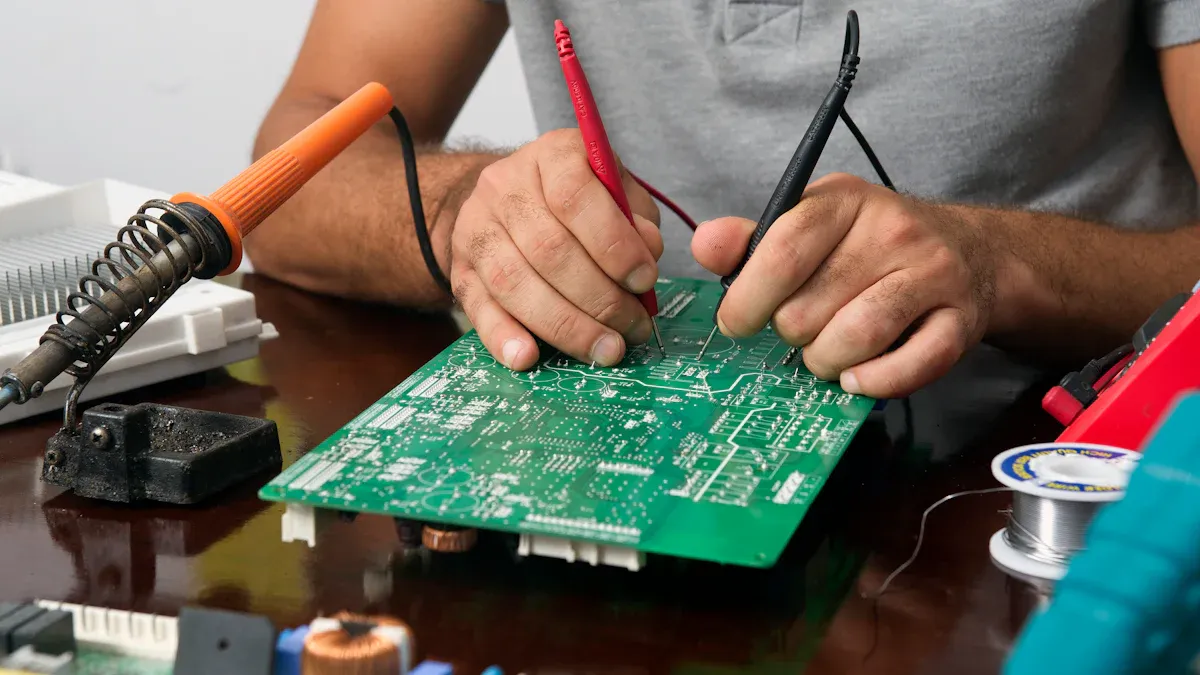
Electronic component quality inspection helps keep your supply chain safe. Bad or fake electronic components can break things and cause danger. They can also break rules. You need to check electronic quality at every step. Early checks find problems like wrong parts or dirt. This way, only good electronic components go to your factory. Trust grows when you work with partners who use world quality rules. They use electronic quality control tools like Statistical Process Control. > Trust in electronic quality control systems helps you avoid bad electronic components and keeps quality high at every step. Pick a company that cares about quality checks and good electronic component quality.
Key Takeaways
-
Quality inspections find defects and fake parts early. This keeps your supply chain safe and reliable. Using visual, chemical, electrical, and advanced tests helps find problems. These tests stop bad parts from reaching customers. Following rules and standards protects your business from fines. It also stops recalls and keeps your reputation safe. Strong quality control makes products work better. It makes customers happy and lowers returns. Picking skilled inspectors and modern tools gives accurate checks. This builds trust in your supply chain.
Ensuring Reliability
Preventing Defects
You want your products to work well every time. Quality inspections help find defects before parts reach your assembly line. Many problems in semiconductors and other parts come from too much electricity, broken circuits, or mistakes during making. For example, scratches on the die, bad wire bonding, or layers not lined up can make parts fail early. On printed circuit boards, you might see breaks at solder joints or bending from heat and water. These issues can cause devices to stop working and lose trust.
Quality control teams use special tools to spot these problems. They look for bending, cracks, and other stress signs. Finding these problems early keeps products safe and helps avoid expensive recalls. When you use good quality checks, you know your supply chain gives you reliable electronic components.
Tip: Early failures, called the "infant mortality" phase, often happen because of hidden defects. Quality inspections and burn-in testing remove weak parts before they reach customers. This makes products more reliable and lowers warranty costs.
Counterfeit Protection
Fake electronic components can hurt your products and your company’s name. Quality inspections help keep these bad parts out of your supply chain. You can use different ways to find fake semiconductors:
-
Visual inspection: Look at packaging, labels, and markings for mistakes.
-
Chemical tests: Use chemicals to check for changes on the surface.
-
Physical checks: Compare size, lead count, and looks with real samples.
-
Electrical tests: Use meters to check basic electrical features.
-
Advanced inspection: Use X-ray, decapsulation, or scanning acoustic microscopy to see inside.
Using steps in order helps you save money and still check well. Start with simple checks, then use advanced ones if you see a problem. Quality control teams follow these steps to make sure only real electronic components enter your supply chain. This keeps your products working and your customers safe.
Compliance and Safety
You must follow strict rules in every big market. Quality inspections and control systems help you make sure your electronic components follow all rules. Checking compliance covers dangerous substances, electrical safety, electromagnetic compatibility, and more. Here is a quick look at important rules:
Region | Key Regulations / Directives | Scope and Requirements |
|---|---|---|
EU | RoHS, LVD, EMC, RED, Cyber Resilience Act, GPSD, Toy Safety Regulation | Limits dangerous substances, checks electrical safety, controls emissions, sets radio rules, needs cybersecurity, and asks for safety checks. |
US | FCC, CPSIA, California Proposition 65 | Controls electromagnetic interference, keeps kids’ products safe, and needs chemical warnings. |
China | China RoHS, CCC, SRRC, NAL | Limits dangerous substances, needs product safety checks, and asks for telecom equipment licenses. |
If you do not follow these rules, you can have big problems. You might get sued, pay fines, recall products, or get banned from markets. Product laws make you responsible for defects, even if the maker caused them. You need to find important safety parts, check risks, and give clear warnings and instructions. Watching products after selling helps you find and fix safety problems fast.
Note: Not following rules can hurt your company’s name, cost more money, and stop you from selling in some places. Quality control and regular checks keep your products safe and your business strong.
Why Quality Matters
Impact on Performance
You need electronic components to work well in every device. These parts must handle heat, shaking, and wet air. If you use parts with clear date codes and store them right, you stop problems like rust or weak materials. These problems can make devices work badly or even break. Checking quality and testing often helps you avoid these risks. When you care about quality at every step, your devices last longer and work better.
-
Good parts help your products work without problems.
-
Careful making and testing make things last longer.
-
Quality checks make sure your devices are always good.
When you test well and keep quality high, your customers get better products and fewer problems.
Customer Satisfaction
Your customers want safe and easy-to-use products. Good electronic parts make people happy because your devices work as they should. Strong quality checks lower the chance of shocks, shorts, or other dangers. Testing for strength and use makes sure your products fit what customers want.
-
Good products make customers come back to buy again.
-
Quality checks help people trust your brand.
-
Happy customers tell others and give good reviews.
Quality is not just about passing tests. It is about making customers feel good about what they buy.
Reducing Returns
Returns can hurt your business and make people think badly of you. Quality checks and testing find bad products before they reach customers. You can stop problems like wrong labels, broken boxes, or things that do not work. Using data from checks helps you see problems early and fix them fast.
-
Quality checks and tests stop bad products from leaving the factory.
-
Looking at what customers say helps you check the right things.
-
Checking quality early means fewer returns and more money for you.
-
Good products mean less waste and help the planet.
Showing how you check quality proves you care and helps you do better than others.
Electronic Component Quality Inspection Process
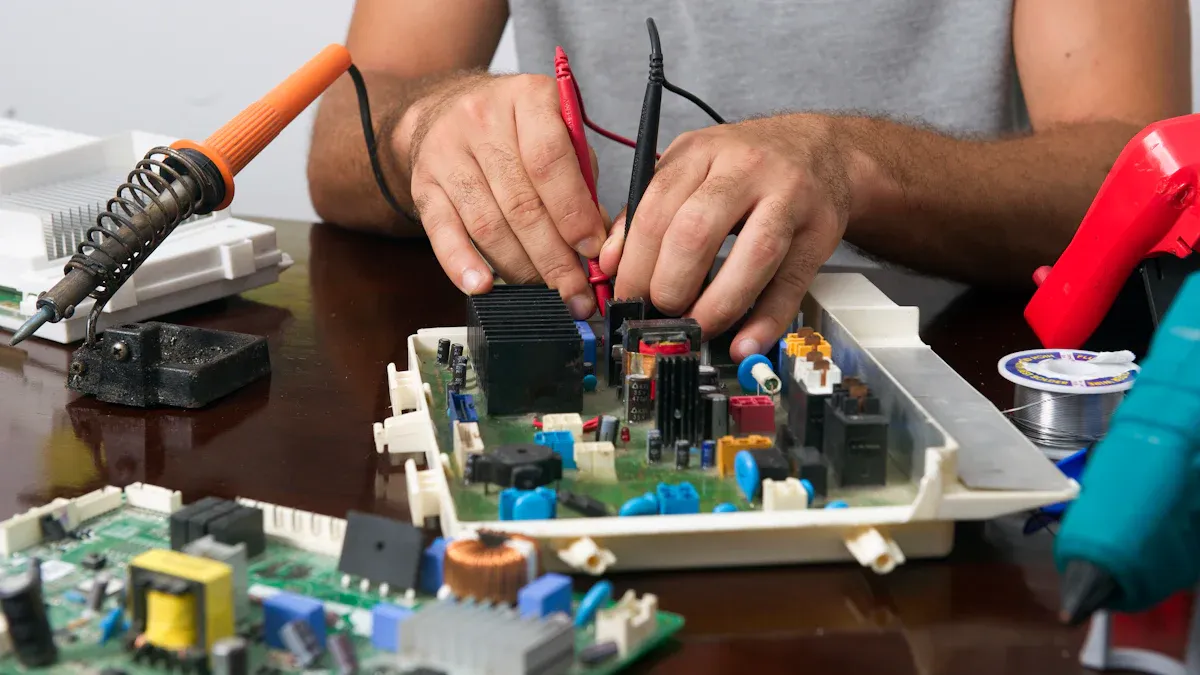
Visual and Physical Checks
You begin by looking at the electronic components closely. This helps you find problems early and keep quality high. Here are the steps you should follow:
-
Check what you need to look for using industry rules like IPC-A-610.
-
Make sure your workspace is clean and safe from static.
-
Use bright lights so you can see everything clearly.
-
Use tools like digital microscopes to see small details.
-
Look at each board carefully. Check where parts are, the solder joints, and look for common problems.
-
Write down what you find on checklists so you can track it.
-
Go over all the problems you found and make reports to fix them.
Physical checks use safe methods like X-ray to find hidden cracks. You also use electrical tests and thermal cameras to spot issues. Automated Optical Inspection, or AOI, helps you find problems like solder bridges, missing parts, or stains. The table below shows some common problems and how you can find them:
Defect Type | Description | Identification Method |
|---|---|---|
Misaligned Components | Parts not lined up, causing poor connections. | Visual Inspection |
Cold Solder Joints | Dull or grainy solder, leading to weak bonds. | Visual Inspection |
Solder Bridges | Unwanted connections causing shorts. | Visual Inspection / AOI |
Insufficient Solder | Not enough solder, causing open circuits. | Visual Inspection / AOI |
Lifted Pads or Traces | Pads or traces lifted from the board. | Visual Inspection |
Cracks or Breaks | Physical cracks in the board. | Visual and Physical Inspection |
Corrosion | Damage from chemicals or moisture. | Visual Inspection |
Contamination | Dirt or dust causing poor contact. | Visual Inspection |
Tip: Make sure your inspection tools work well and your team knows how to use them. This helps you keep quality high.
Documentation Review
You need to look at all the papers during inspections. Check purchase orders, packing slips, test certificates, and compliance papers. Make sure the electronic components match the order, like part number, maker, and date code. Always check these papers:
-
Product specifications
-
Test reports
-
Certifications
-
Quality control records
If papers are missing or not complete, it could mean fake or bad parts. You should check lot codes and supplier papers using maker databases. Keep good records of every step you check. This helps you track parts and follow the rules.
Functional Testing
Functional testing checks if the electronic components work right. You use different ways in the 100-point inspection:
Test Type | Description |
|---|---|
In-Circuit Testing (ICT) | Checks each part on the board for shorts, opens, and wrong values. |
Functional Testing | Simulates real use to see if hardware works as expected. |
Multimeter Testing | Measures voltage, current, and resistance to find faults. |
Oscilloscope Analysis | Shows signal waveforms to check for problems. |
Continuity Testing | Checks for complete paths and finds breaks. |
Capacitance & Inductance Testing | Measures storage and coil values. |
Frequency Testing | Checks signal frequency for accuracy. |
Signal Generator Usage | Sends signals to test circuit response. |
Functional testing alone does not show if parts will last a long time. You need to use other tests like HALT or burn-in testing to find early failures and make things more reliable. These tests help you know how parts will work over time.
Packaging Inspection
You finish by checking the packaging. Look at boxes, labels, and seals for damage or signs someone opened them. Make sure the packaging matches the papers and keeps parts safe from water, dust, and static. Good packaging keeps parts safe when shipping and storing. Always check packaging at the end to make sure parts are reliable and stay high quality.
Note: Using both your own tests and outside lab tests with advanced tools gives you the best results. Use both to make your inspection process stronger.
Electronic Quality Control Systems
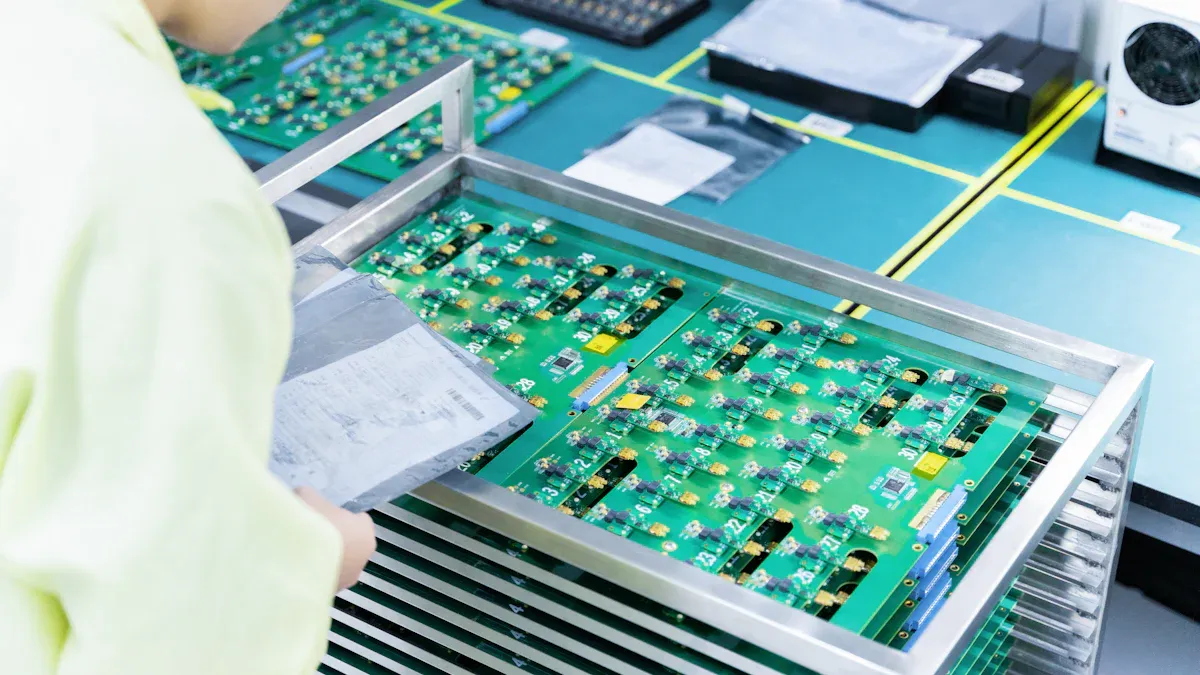
Risk-Based Approaches
You can make your electronic quality control better by using risk-based ways. This helps you look at the biggest risks in your supply chain first. You use tools like Risk Assessment and Categorization Tool (RACT) to find and sort risks. Key Risk Indicators (KRIs) help you see problems before they get worse. Quality Tolerance Limits (QTLs) show you when something is not safe. Centralized Statistical Monitoring (CSM) lets you check data for hidden problems.
Key Element | Description |
|---|---|
Risk Assessment and Categorization Tool (RACT) | Finds and ranks risks using industry methods. |
Key Risk Indicators (KRIs) | Tracks risks and spots problems early. |
Quality Tolerance Limits (QTLs) | Sets limits to show when you need to act. |
Centralized Statistical Monitoring (CSM) | Uses data to find issues without on-site checks. |
Risk-based inspection helps you focus on the most serious dangers. This saves you time and money. You can find problems early and keep your semiconductor supply chain safe. You also follow the rules and make your quality control better. This way, you make good choices and keep your quality control strong.
Quality Management Systems
You need a strong quality management system for electronic quality control. These systems follow strict quality assurance rules. They help you watch every step in your quality control work. You use standards like ISO 9001:2015, AS9100D, and AS5553 to guide you. These standards cover quality control in semiconductor distribution, safety, and following rules.
Standard/Certification | Focus Area | Key Points for Electronic Quality Control |
|---|---|---|
ISO 9001:2015 | General QMS | Ensures steady product quality and compliance. |
AS9100D | Aerospace | Adds rules for counterfeit prevention and supplier quality management. |
AS5553 | Counterfeit Parts | Guides you to avoid and detect fake parts. |
AS6081 | Distribution | Sets rules for finding and removing bad parts. |
IDEA-QMS-9090 | Quality Control | Focuses on quality control in semiconductor distribution. |
These systems help you keep your quality control up to date. They help you follow the rules and make your quality better. You also use them to teach your team and check your supplier quality management. This keeps your semiconductor products safe and reliable.
Supplier Audits
Supplier audits are important for electronic quality control. You use them to check if your suppliers follow your quality control rules. You set clear rules and work with your suppliers to meet them. Regular audits help you find problems early and fix them fast. You talk openly and give feedback to build trust.
-
You check your suppliers with third-party audits.
-
You set clear quality goals together.
-
You hold meetings to talk about quality control in semiconductor distribution.
-
You review results and give feedback often.
Supplier audits help you keep high quality and strong supplier quality management. They make sure your suppliers follow the rules and your quality control steps. This keeps your supply chain safe and your products strong.
Tip: Doing supplier audits often helps you find risks before they cause trouble. They also help you work better with your suppliers.
Choosing Electronic Components Quality Inspections Providers
Technology and Tools
You need new technology to check electronic components well. Top companies use AOI, 2D/3D machine vision, and fast laser scanners. These tools find small problems that people cannot see. Many companies now use AI and machine learning to spot more defects. This makes checks faster and more correct.
Company Name | Specialization and Technology Focus |
|---|---|
Koh Young Technology | AOI and solder paste inspection with innovative 3D solutions |
CyberOptics Corporation | High-precision AOI and SPI systems for semiconductors |
Mirtec Co., Ltd. | AI-driven advanced AOI inspection technologies |
Omron Corporation | High-performance AOI systems for PCB and industrial uses |
Viscom AG | Comprehensive AOI systems for diverse environments |
You also use barcode readers to track parts and SCADA systems to watch in real time. These tools help you make sure every part is good. When you pick a company with new tools, you can trust your supply chain.
Inspector Expertise
Inspector skill is very important for quality control. Good inspectors use X-ray, SEM, and OCR to find fake or broken parts. They know how to use visual checks, magnifiers, and measuring tools to find tiny problems. Providers with certified inspectors show they care about quality. Their skills help keep your products safe and checks correct.
You should pick providers who train and certify their inspectors. This helps you trust their work and keeps your quality high. When skilled inspectors use new tools, you get the best checks for your parts.
Reporting and Transparency
Clear reports help you manage supplier quality. You need reports that show what was checked, what was found, and what was done. Good companies give you easy reports with photos, data, and clear answers. This helps you fix problems fast and make good choices.
Pick companies that share information and answer your questions. This builds trust and keeps your quality strong. You should also check if the company works worldwide and has the right papers. Working with certified labs and using best practices keeps your supply chain safe and your products good.
Tip: Always look at sample reports before you choose a company. Good reports show the company cares about quality and being open.
Overcoming Supply Chain Challenges
Counterfeit Risk
Counterfeit electronic components are a big problem in your supply chain. Fake parts can get in when there are shortages or you need to fill orders fast. Quality inspection services help you stop this risk. They check every batch of electronic components with special tools like X-ray and decapsulation. Trusted labs use strict rules and look at markings, how the parts look, and how they work. You can also make a group of trusted suppliers and use alerts to find problems early. By saving supplier information and doing regular checks, you keep your quality control strong and stop fake parts before they reach your products.
Tip: Check your components with global databases. This helps you find fake parts fast and keeps your supply chain safe.
Supply Chain Complexity
Modern supply chains have many suppliers, places, and factories. Each part of the chain can change your product’s quality. One bad part from a supplier can mess up your whole business. You need to check quality at every step. Use good tests and clear rules to find problems early. Use more than one supplier, but always check them and see how they do. Good relationships and talking often help you get what you need during shortages and keep quality high.
-
Rushing to buy parts can make quality worse.
-
Trouble in one place can hurt your whole business.
-
Picking good suppliers and checking them often keeps your business safe.
Consistent Quality
You need all your electronic components to be the same good quality, no matter where they come from. Make strong quality control rules and test at every step. Use your own checks and outside checks to find problems early. Keep good records and look at them often. When you care about quality, you protect your brand and avoid expensive recalls. Good quality control keeps your products working well and your customers happy.
Note: Keeping quality the same builds trust with your customers and keeps your business strong, even when the supply chain is hard.
When you use strong electronic quality control, your supply chain is safer. This helps lower the number of defects by 20%. It also makes your products more consistent by 12%. You will have fewer delays and save money by avoiding rework. Expert inspectors use barcode scanning, visual checks, and lab tests to keep parts safe. You can trust your products if you use a 100-point inspection process. Look at your current electronic quality control steps. Change your rules or ask trusted partners for help. Act now to keep your electronic components reliable and your business strong.
FAQ
What is electronic component quality inspection?
You use electronic component quality inspection to check if parts meet your standards. This process finds defects, fake parts, and safety risks. You keep your supply chain strong and your products safe by using these checks.
How often should you inspect electronic components?
You should inspect every batch you receive. Regular checks help you catch problems early. You can also set extra inspections for high-risk suppliers or new parts.
Why do you need third-party inspection services?
Third-party inspection services give you expert checks and unbiased results. You get access to advanced tools and skilled inspectors. This helps you trust your supply chain and avoid costly mistakes.
What happens if you skip quality inspections?
If you skip inspections, you risk using bad or fake parts. Your products may fail, and your company could lose trust. You might also face legal trouble or recalls.


